Alzheimer’s: When to Stop Driving
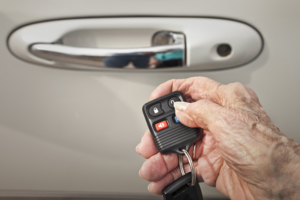 Driving is a powerful symbol of competence and independence—besides being a routine part of adult life. But the focused concentration and quick reaction time needed for safe driving tend to decline as one ages, and for a person with Alzheimer’s disease, this process accelerates dramatically.
More than memory problems
Alzheimer’s robs people of their short-term memory, so they get lost easily, sometimes even in familiar territory. A decline in visuospatial skills, which help drivers judge distances and predict upcoming traffic problems, plays a large role in making people with Alzheimer’s unsafe drivers.
Those with Alzheimer’s also have trouble prioritizing visual cues. An irrelevant sight, such as a dog jumping behind a fence, may distract them, so they might fail to notice important cues, such as brake lights or traffic signs.
Pre-emptive measures as the disease progresses
Even if your loved one willingly gives up driving at first, it may become an issue later on, as his or her understanding of the risks diminishes. Here are some strategies for keeping your loved one out of the driver’s seat.
- Get a note from the doctor. Sometimes it helps if an authority figure—physician, lawyer, insurance
agent—tells your loved one to stop driving. Having something in writing can be a useful reminder. Additionally, a note from the doctor can be sent to the Department of Motor Vehicles to rescind a license if the person is unwilling to give up driving or take a driving test. - Control access to the car and keys. In many cases, it’s a simple matter of “out of sight, out of mind.” Parking the car around the corner may be enough. If your loved one insists on carrying a set of car keys, you can replace them with keys that don’t work.
- Disable the car. Removing a battery cable will prevent the car from starting. Or a mechanic can install a “kill switch” that must be engaged before the car can start.
- Ease the transition. Arrange for alternative transportation, perhaps via the city bus service or a senior van route, or utilize the services of CareWorks Health Sevices, which can provide transportation to social events, doctors’ or hair appointments or outings to the grocery store, park, church, etc.
The transition
Most specialists feel it’s important to help the person with dementia stop driving as soon as possible. A rule of thumb is to ask yourself whether you feel safe riding in a car or having your family members, including children, riding in a car that the person with dementia is driving. Ask yourself if you would feel safe with your children playing on the sidewalk on a street where the person with dementia is driving. If the answer is no, then you know it’s time for him or her to retire from driving.
If the person will not stop voluntarily, it is important to check with the state Department of Motor Vehicles to find out the procedure for evaluating the person’s driving ability. Many facilities offer a thorough “driver safety evaluation” to determine whether it is safe for the person to continue driving.
When to stop driving
Because Alzheimer’s diminishes reasoning skills, the person may resist the request to stop driving. It often is up to caregivers to determine when their loved ones become unsafe behind the wheel. Warning signs of unsafe driving include:
- Forgetting how to locate familiar places
- Braking harder than normal for stoplights and stop signs
- Difficulty seeing things on the road
- Problems with changing lanes or making turns
- Running through stop signs
- Difficulty maintaining the car in the center of the lane
- Making slow or poor decisions
- Trouble turning his or her head before changing lanes
- Hitting the curb while driving
- Driving at an inappropriate speed
- Trouble adjusting to the oncoming glare of headlights
- Increased frustration, anger or anxiety when driving
- Failure to use turn signals or mirrors
- Becoming angry and confused while driving
- Confusing the brake and gas pedal
- Increased confrontation with other drivers
- Failing to observe traffic signals or running through stop signs
- Becoming confused in simple driving situations or lost in familiar areas
- A series of close calls, collisions, or driving violations, even if they are minor
Be patient and firm
When your loved one stops driving, be as patient as you can throughout this process, but remember to stand firm. Arguments and explanations rarely make it easier to accept. Instead of arguing, provide other ways of getting around and maintaining routines.
What will help is to keep routines as normal as possible despite the prohibition on driving. Arrange for family and friends to visit regularly and to take your loved one out to run errands. When you’re together, focus on activities your loved one can still do and enjoy.
CareWorks Health Services is always available to assist with transportation needs, and to provide resources to make the transition easier. Contact our Orange County senior care team today to learn more about our services.
Click here to download a printable PDF version of this page.
Tips courtesy of: Mayo Clinic and U.S News & World Report