Prevent Injury! Use Proper Body Mechanics for Lifting and Transferring
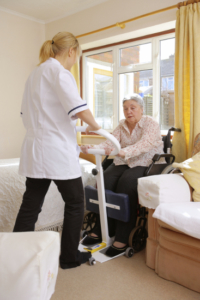 52% of caregivers are injured as a result of lifting or transferring. Learning the proper body mechanics for lifting and transferring loved ones who need assistance will help to prevent injury, avoid fatigue and make the best use of strength.
NOTE: Never try to lift a frail person who has fallen onto the floor by yourself. Make the person as comfortable as possible and get help!
To get a printable Body Mechanics for Caregivers Handout, click here.
General Tips for Lifts and Transfers
- Never lift more than you can comfortably handle.
- Let the person do as much as he or she is capable of during the lift or transfer. If the person cannot assist with the transfer at all, you may require special training and/or adaptive equipment for lifts or transfers.
- Work at the person’s level and speed and check for pain.
- Avoid sudden jerking motions.
- Never pull on the person’s arms or shoulders.
- Have the person wear shoes with good treads or sturdy slippers.
- Create a base of support by standing with your feet shoulder width apart with one foot a half-step in front of the other.
- Let your legs do the lifting, not your back.
- Avoid letting the person put her arms around your neck or grab you. If the person is fearful, have her clasp her hands close to her chest during the lift or transfer.
- Breathe deeply and keep shoulders relaxed.
Assistance from Lying Down to Sitting Up
- Tell the person what you are going to do.
- Bend the person’s knees.
- Roll her onto her side so that she is facing you.
- Reach one arm under her shoulder blades.
- Place the other arm behind her knees.
- Position your feet shoulder width apart for stability.
- Get close to the bed and the person.
- Keep your back in a neutral position.
- Count aloud “1-2-3” and shift your weight to your back leg.
- Shift the person’s legs over the edge of the bed while pulling her shoulders to a sitting position.
- Remain in front of her until she is in a stable position.
Transfers from a Bed to a Wheelchair
- If the bed is low, put one foot on a footstool. This relieves pressure on your lower back.
- Place the wheelchair as close to the bed as possible and check the wheelchair position. Are the brakes locked, and armrests and footrests swung out of the way?
- Tell the person what you are going to do and let him look to where he is being transferred. Before starting a move, count “1-2-3”.
- If the person is able, place his hands on the bed so he can assist in the movement.
- For better support, get close to the person you are lifting.
- Bend at the knees and not the waist, keeping your back and neck in a straight line with weight balanced on both feet. Tighten your stomach and back muscles to maintain a correct support position.
- Use your arms to support the person and let your legs do the lifting.
- Pivot by turning on one foot rather than twisting your body.
- A transfer belt around the person’s waist can be used for stability and support as you complete the transfer.
- Tell the person to hold the wheelchair armrests for support (if able).
To lift or not to lift?
Knowing when to call for help is as important as knowing how to help. Back or shoulder injuries resulting from improper lifting or transferring put the caregivers and their loved ones at risk.
Prevent family caregiver injuries through proper body mechanics for lifting patients. CareWorks Health Services can provide information on when to lift, how to correctly lift or transfer in different scenarios, and how to use assistive devices. Our caregivers receive ongoing training on injury prevention through Brasstacks LMS, which delivers text based microlearning modules, which they access easily on their phones.
Contact CareWorks Health Services today at (949) 859-4700 or (714) 421-4005 or fill out the contact form on our contact page to learn more about our home care services.
Click here to download a printable PDF version of this page.
Sources: Centre for Enabled Living, Amputee Coalition, Washington State Department of Social and Health Services Caregiver Handbook